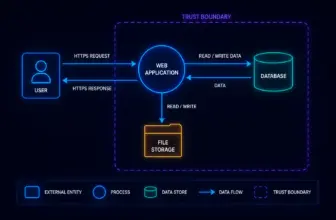
Securing a network you don’t fully understand is a losing proposition. Most organizations operate that way — responding to findings, patching vulnerabilities, adjusting rules — without a structured understanding of what the network is, what it does, and what depends on what. Network architecture provides that structure. Conceptual, logical, and physical — three layers that, worked through in order, give you the foundation for every security decision that follows: asset inventory, criticality assessment, control placement, and cost justification.
Physical design in this context refers to network infrastructure — hardware, cabling, device placement. It has nothing to do with physical security, which is a separate discipline covering locks, cameras, and access controls.
Conceptual Design
The conceptual layer is a high-level overview of why the network exists — the organizational goals, missions, and objectives it’s built to support. This is not a technical document. It doesn’t describe how anything is configured. It answers the question: what does this network need to do?
At this level you’re identifying core components — internal and external systems, critical processes, the services those processes depend on, and the people who use them. You’re mapping data flows and understanding system behavior. What information moves through this network? Where does it come from, where does it go, and what happens if it doesn’t arrive?
Regulatory, legal, and safety considerations belong here too. If the network supports healthcare systems, HIPAA applies. If it touches payment processing, PCI DSS is relevant. If it controls industrial equipment, safety implications come into scope. These aren’t afterthoughts — bolting compliance and legal requirements onto a design after the fact creates gaps, increases cost, and usually means rework.
Only from the conceptual design can you establish criticality. If you don’t know that a particular server supports a process that the organization cannot function without, you can’t prioritize its protection appropriately.
Logical Design
The logical design takes the conceptual understanding and maps it into network diagrams. This is where you represent the components — servers, segments, zones, external connections — and the relationships between them. Data flows become explicit and dependencies become visible. What was described in words at the conceptual level is now drawn.
The logical design still doesn’t get into specifics like OS versions or IP addresses. It’s concerned with what is required to perform the organization’s objectives and how those requirements connect to each other. A web application that depends on a database, which depends on a directory service, which depends on an authentication system — that chain of dependency is a logical design concern.
Understanding those interdependencies is what allows you to reason about failure and attack paths. If an attacker compromises the authentication system in that chain, what else becomes reachable? If the database goes down, what stops working? The logical design makes those questions answerable.
Physical Design
The physical design is where the specifics live. Based on the logical design, it provides the detailed aspects of every network component — operating system versions, patch levels, configurations, IP addressing, hardware specifications, cabling runs, and risks associated with each element.
This is the layer most practitioners are comfortable with because it’s tangible. You can touch a switch, read a config file, run a vulnerability scan. But the physical design only makes sense in context of the logical and conceptual layers above it. A misconfigured firewall rule is a technical finding — but whether it matters depends on what’s behind it, which is a logical and conceptual question.
Why the Order Matters
The conceptual informs logical, logical informs physical. Skipping to physical design means you’re making security decisions without understanding what you’re protecting or why it matters.
The practical consequence is that you end up with security controls placed based on convention or vendor recommendations rather than actual risk. Firewalls everywhere, logging everywhere, scanning everywhere — but no clear reasoning for why a particular control exists at a particular point, and no way to evaluate whether the cost is justified by the criticality of what it protects.
Working through all three levels gives you something more valuable than a network diagram. It gives you a defensible understanding of your environment — what’s in it, what it does, what depends on what, and where protection is actually warranted. From there you can place the right controls at the right places, justify the cost, and explain the reasoning to anyone who asks.
The output of this process isn’t just documentation. It’s the ability to answer: what do we have, what does it do, how critical is it, and what would it cost us to lose it? Without those answers, security spending is a guess.
This is the first in a series of posts working through network security fundamentals. Each one covers a concept worth understanding clearly before reaching for a tool or a config.