The first post in this series made the point that you can’t secure what you don’t understand. Asset management is where that understanding becomes concrete. Before you can assess risk, place controls, or respond to an incident effectively, you need to know what assets exist, what they’re worth to the organization, and how critical they are to operations.
Most organizations have a partial answer to that question at best. IT knows what’s on the network. Finance knows what’s on the books. Business units know what they depend on. None of them has the full picture, and nobody has assigned security-relevant values to any of it. That gap is also a compliance gap — virtually every major security framework, from ISO 27001 to NIST CSF to CIS Controls, treats asset inventory and classification as a foundational requirement, not an optional starting point.
Tangible and Intangible Assets
Assets fall into two broad categories, and both matter to a security program. The tendency is to focus on tangible assets because they’re easier to enumerate — you can see a server, scan a subnet, pull a hardware inventory. Intangible assets require more deliberate effort to identify but often carry more value and more risk.
Tangible Assets
- Servers and workstations
- Network infrastructure — switches, routers, firewalls
- Storage systems and databases
- Mobile devices and endpoints
- Physical facilities and data centers
- Printers, peripherals, and IoT devices
Intangible Assets
- Customer data and personally identifiable information
- Intellectual property and proprietary processes
- Source code and software
- Financial records and contractual data
- Brand reputation
- Credentials, certificates, and cryptographic keys
Intangible assets are often the ones that matter most in a breach. Customer data, intellectual property, financial records — the loss or exposure of these carries consequences that hardware replacement doesn’t. A stolen laptop is recoverable. Exfiltrated customer records are not. From a compliance standpoint, intangible assets are also where most regulatory obligations attach — HIPAA, PCI DSS, and GDPR care about the data, not the server it sits on.
Identifying Assets
Asset identification isn’t a solo exercise. It requires conversations across the organization because no single team has visibility into everything.
The IT department is the starting point for tangible assets. Network scans, endpoint management tools, and existing infrastructure documentation give you a baseline. But IT’s inventory is often incomplete — shadow IT, personally owned devices, cloud resources spun up outside of formal procurement, and assets acquired through mergers or acquisitions frequently don’t make it into the official register.
Business units are where you find the intangible assets and the context that makes tangible assets meaningful. A database server is an IT asset. A database server that contains the organization’s entire customer history and feeds the billing system is a critical business asset. That distinction only comes from talking to the people who own and depend on those systems. What data do you work with? What systems can’t you operate without? What would stop the business if it went down or was compromised?
IT can tell you what exists. Business owners can tell you what matters. Asset identification without input from both produces an incomplete and misleading picture — and an incomplete asset inventory means your risk assessment is missing inputs, your compliance scope may be wrong, and your controls are placed without full context. A server that IT has flagged as low-priority may be the system a business unit cannot operate without for a single day.
Assigning Value and Criticality
Once assets are identified, they need to be valued — not just in financial terms, but in terms of what their loss, compromise, or unavailability would mean for the organization. This is where criticality comes in.
Value has multiple dimensions. Replacement cost is one — what does it cost to replace or rebuild this asset? But operational value is often more significant: what revenue, processes, or obligations depend on this asset functioning correctly? And regulatory value matters too: does this asset hold data subject to HIPAA, PCI DSS, GDPR, or other frameworks? A system that holds regulated data carries value and risk beyond its operational importance, because a breach doesn’t just stop operations — it triggers notification obligations, regulatory scrutiny, and potential liability.
Criticality is the assessment of what happens to the organization if this asset is unavailable, compromised, or destroyed. High criticality assets are those where the impact is immediate and significant — a payment processing system, a core authentication service, a primary database. Lower criticality assets can tolerate longer recovery windows or have redundancy built in. Both value and criticality should be assigned with input from business owners, not determined unilaterally by IT or security.
Classification
Classification organizes assets by sensitivity and handling requirements. A common framework uses tiers — public, internal, confidential, restricted — with each tier carrying different access, handling, and protection requirements. Data classification in particular drives a significant portion of security control decisions: what gets encrypted, who can access it, where it can be stored, how long it’s retained, and how it must be disposed of.
Classification only works if it’s applied consistently and maintained over time. Data that starts as internal can become confidential when a business relationship changes or a regulatory obligation kicks in. Assets that start as low criticality can become high criticality as the organization grows to depend on them. Classification is not a one-time exercise — it’s a continuous process that has to be resourced and owned.
The CMDB Problem
A Configuration Management Database is the system of record for assets and their relationships. In principle, it’s the authoritative source for what exists in the environment, what it’s connected to, and what depends on it. In practice, most CMDBs are incomplete, out of date, or populated with technical attributes that don’t reflect security-relevant context.
A CMDB that contains IP addresses, hostnames, and serial numbers is an IT inventory. A CMDB that also contains asset classification, criticality rating, data sensitivity, business owner, regulatory obligations, and last review date is a security asset register — and the difference matters enormously when you’re trying to demonstrate compliance, assess risk, or explain your control rationale to an auditor.
At minimum, each asset record should include: asset owner, business function supported, data classification, criticality rating, applicable regulatory frameworks, and date of last review. An IP address and a hostname tell you where something is. Classification and criticality tell you why it matters, what controls it needs, and what you’re required to report if something goes wrong with it.
Maintaining a useful CMDB requires organizational commitment, not just technical tooling. Someone has to own the process of keeping it current, which means regular reviews with business owners, automated discovery to catch unregistered assets, and a process for handling assets that are decommissioned, transferred, or acquired.
Why It Fails in Practice
Asset management is one of those things that looks straightforward on paper and breaks down consistently in the real world. In large organizations the problem compounds — assets span multiple countries, jurisdictions, business units, and IT environments that may have never been consolidated. What counts as an asset, who owns it, and what system it should be tracked in often has no consistent answer.
Underfunding is a recurring factor. Asset management doesn’t produce alerts or block attacks, so it gets deprioritized when teams are already running at capacity. Nobody gets credit for maintaining an accurate inventory. Everybody notices when the inventory is wrong after an incident — or during an audit when the scope of regulated data turns out to be larger than anyone thought.
Procurement is a specific and underappreciated failure point. Hardware purchased outside of formal IT processes — by a business unit, through a subsidiary, or during an acquisition — can enter the environment undocumented. Nobody registers it, nobody knows it needs to be protected, and nobody is watching it. Undocumented assets with no owner and no security controls are a reliable way an organization gets compromised and a reliable way an organization fails a compliance audit.
Every asset needs a named owner — an individual or team responsible for its security, classification, and ongoing review. Without assigned ownership, asset management becomes a collective responsibility that nobody actually takes. This matters operationally and from a compliance standpoint: ISO 27001 A.5.9 requires that an inventory of assets exists and is maintained, and A.5.10 requires that assets have identified owners. Ownership documented in the CMDB is the evidence that satisfies both.
The bottom line is that asset management is continuous, not a project. The environment changes constantly — systems are added, removed, transferred, and acquired. A register that was accurate six months ago may be significantly incomplete today. Treating it as a one-time deliverable guarantees it will be wrong when it matters most, whether that’s during an incident or during an assessment.
Control Mapping
Asset management maps directly to foundational controls in every major security framework. The controls below aren’t aspirational — they’re the minimum baseline most assessments will look for evidence of.
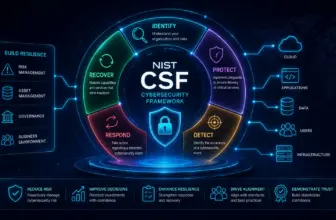
NIST CSF ID.AM (Asset Management) is the first function in the Identify category for a reason — asset management is the prerequisite for everything else the framework asks you to do. ID.AM-1 requires that physical devices and systems are inventoried. ID.AM-2 requires that software platforms and applications are inventoried. ID.AM-5 requires that resources are prioritized based on classification, criticality, and business value. None of the subsequent risk management or protection functions can be performed meaningfully without this foundation.
ISO 27001 A.5.9 and A.5.10 require an inventory of information and associated assets with identified owners respectively. These are Annex A controls that directly inform the scope of an ISO 27001 certification — without an accurate asset inventory, the scope statement is unreliable and the risk assessment that follows it is built on incomplete information.
CIS Controls 1 and 2 (Enterprise Asset Management and Software Asset Management) sit at the top of the CIS prioritization model for the same reason as NIST CSF — you can’t defend what you can’t see. CIS explicitly notes that these controls are foundational: organizations that haven’t completed them cannot reliably implement the controls that follow.
Asset identification, valuation, and classification aren’t the most visible parts of a security program. They don’t produce alerts or block attacks. But they’re the foundation that makes risk assessment meaningful, control placement defensible, and incident response coherent — and they’re the first thing an assessor will ask for evidence of.